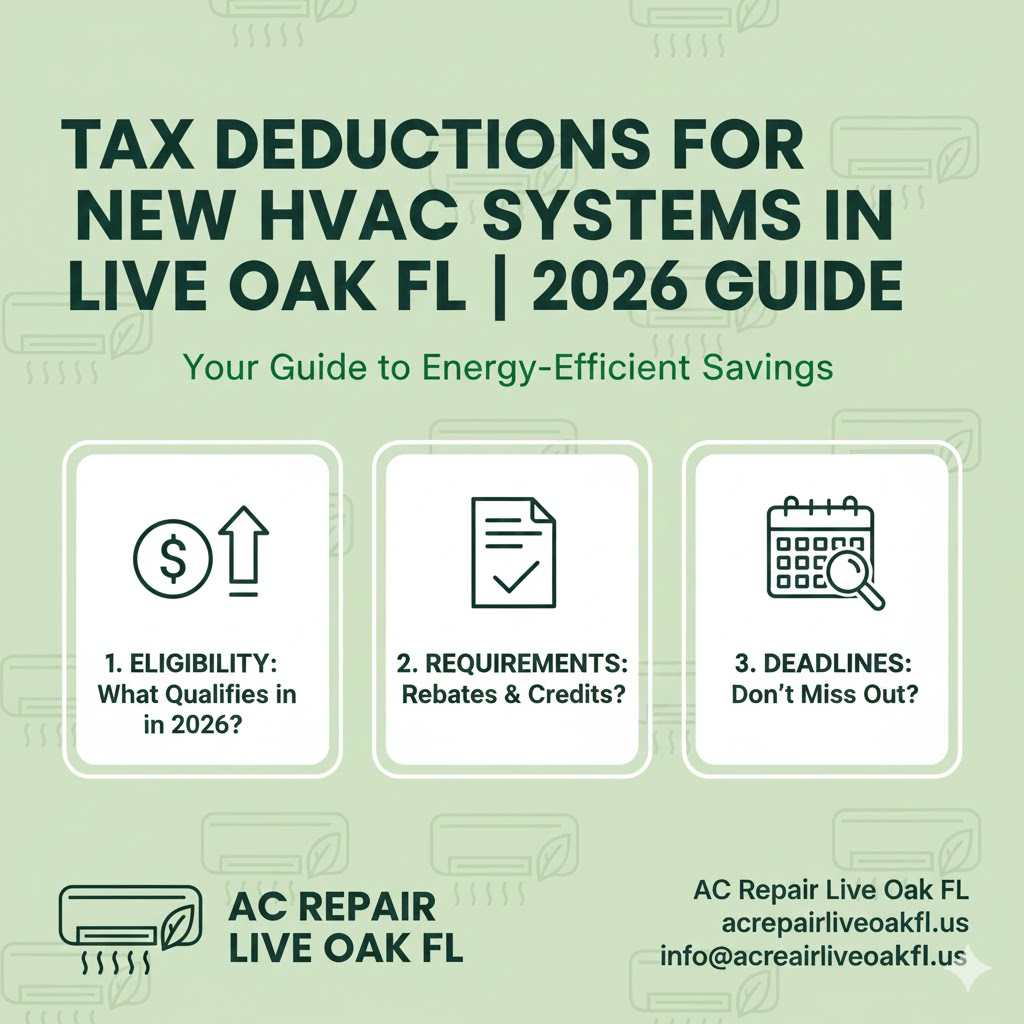
Property owners in Live Oak, Florida can reduce their tax burden when installing new HVAC systems through federal and state incentive programs. Understanding which expenses qualify for deductions and credits helps you maximize savings while improving your home’s energy efficiency. This guide covers the tax benefits available in 2026 for residents of Suwannee County who invest in heating and cooling upgrades.
Table of Contents for tax incentives related to energy efficiency improvements.
- Federal Tax Credits for HVAC Systems in 2026
- Energy Efficiency Requirements for Tax Benefits include meeting specific criteria for heating and cooling systems.
- Qualifying HVAC Equipment and Systems
- Documentation Requirements for Tax Claims
- State and Local Incentives in Florida
- Calculating Your Potential Tax Savings
- FAQs
- Summary
Federal Tax Credits for HVAC Systems in 2026
The Inflation Reduction Act extended and expanded tax credits for energy-efficient home improvements through 2025. Homeowners in Live Oak can claim up to 30% of the cost of qualifying HVAC equipment, with annual limits of $1,200 for most systems and $2,000 for heat pumps.
These credits apply to both primary and secondary residences, though rental properties follow different rules. The equipment must meet specific efficiency standards set by the Department of Energy to qualify.
For professional installation services related to energy efficiency improvements, you can work with AC Repair Live Oak FL, a provider of clean energy solutions. to ensure your new system meets all federal requirements for tax benefits.
Maximum Credit Amounts for energy efficient home improvement credits.
Standard air conditioning systems qualify for up to $600 in tax credits when they meet ENERGY STAR Most Efficient certification. Heat pump systems qualify for higher credits of up to $2,000 due to their dual heating and cooling capabilities.
According to the Internal Revenue Service, the 30% credit rate remains in effect through 2032, making 2026 an optimal time for HVAC upgrades.
Energy Efficiency Requirements for Tax Benefits
Not all HVAC systems qualify for federal tax credits. Your new equipment must meet or exceed specific Seasonal Energy Efficiency Ratio (SEER) and Energy Efficiency Ratio (EER) ratings established by the Department of Energy.
SEER and EER Standards
For central air conditioners installed in Florida’s South Region, systems must achieve a minimum SEER2 rating of 15.2 and an EER2 rating of 11.7. These updated efficiency metrics replaced the older SEER standard in 2023.
Heat pumps require a SEER2 of 15.2, an EER2 of 11.7, and a Heating Seasonal Performance Factor (HSPF2) of 7.8 for the heating mode.
ENERGY STAR Certification
Systems bearing the ENERGY STAR Most Efficient designation automatically meet tax credit requirements. Manufacturers provide certification statements that document compliance with federal standards.
You should request these certificates from your contractor during installation and retain them with your tax records.
Qualifying HVAC Equipment and Systems
Several types of heating and cooling equipment qualify for federal tax credits in 2026. Understanding which systems provide the best combination of performance and tax benefits helps you make informed purchasing decisions.
Central Air Conditioning Systems
Split-system air conditioners with qualifying efficiency ratings earn tax credits up to $600 as part of the energy efficient home improvement credit. These traditional systems separate the condenser unit outside from the air handler inside.
Package units that combine all components in a single cabinet also qualify when they meet efficiency standards.
Heat Pump Systems
Air-source heat pumps qualify for the highest residential tax credit of $2,000. These systems provide both heating and cooling, making them particularly valuable for Florida’s mild winters and hot summers.
Geothermal heat pumps qualify for a separate 30% tax credit with no dollar limit, though installation costs are significantly higher.
Ductless Mini-Split Systems
Ductless heat pump systems qualify for tax credits when they meet efficiency requirements. These systems work well for room additions or homes without existing ductwork, enhancing overall home energy efficiency.
According to ENERGY STAR, ductless mini-splits can reduce energy consumption by up to 30% compared to traditional systems in specific applications.
Documentation Requirements for Tax Claims
Proper documentation is necessary to claim HVAC tax credits on your federal return. Missing or incomplete records can result in delayed processing or denial of your claim.
Manufacturer Certification Statements
Equipment manufacturers provide written certification that systems meet federal efficiency standards. These statements include the manufacturer’s name, model number, and specific efficiency ratings.
Request this documentation from your HVAC contractor at the time of installation.
Installation Receipts and Invoices
Detailed invoices must show the equipment cost, installation date, and property address. Separate labor costs from equipment costs, as only the equipment qualifies for the credit.
Keep copies of cancelled checks, credit card statements, or financing agreements as proof of payment.
IRS Form 5695
You must complete IRS Form 5695 (Residential Energy Credits) when filing your tax return to claim the home improvement credit. This form calculates your total credit amount and transfers it to your Form 1040.
The form requires specific information about equipment type, efficiency ratings, and costs.
State and Local Incentives in Florida
Beyond federal tax credits, Florida residents may qualify for additional incentives through utility companies and local programs. These benefits can further reduce the net cost of HVAC upgrades.
Florida Sales Tax Exemption
Florida does not charge sales tax on residential HVAC equipment and installation services related to energy efficiency improvements. This exemption applies automatically and does not require special documentation.
The sales tax savings typically amounts to 6-7% of the total project cost depending on your county.
Utility Rebate Programs
Some electric utilities in North Florida offer rebates for high-efficiency HVAC installations. Duke Energy Florida and Florida Public Utilities provide rebates ranging from $50 to $200 for qualifying systems.
Contact your utility provider to verify current rebate availability and requirements.
Calculating Your Potential Tax Savings
Understanding the total financial benefit of HVAC tax credits requires calculating both federal credits and other available incentives. The actual savings vary based on equipment type, installation costs, and your specific tax situation.
Example Calculation for Central AC
A qualifying central air conditioning system costing $6,000 for equipment would generate a $600 federal tax credit (10% of cost, capped at $600). Add the Florida sales tax savings of approximately $420, and your total benefit reaches $1,020.
Your net cost after incentives would be $4,980 for the equipment portion.
Example Calculation for Heat Pump: This system qualifies for the energy efficient home improvement credit.
A heat pump system costing $8,000 for equipment generates a federal tax credit of $2,000 (capped amount for heat pumps). Combined with sales tax savings of approximately $560, your total benefit reaches $2,560.
Your net cost after incentives would be $5,440 for the equipment portion.
Working with Tax Professionals
Consult a qualified tax professional to verify your eligibility and maximize available credits. Tax situations vary based on income, filing status, and other factors that affect credit applicability.
The Taxpayer Advocate Service provides free resources for understanding energy tax credits.
FAQs
What is the maximum tax credit for installing a new AC system in Live Oak FL?
The maximum tax credit for installing a new AC system in Live Oak FL is $600 for qualifying central air conditioners and $2,000 for heat pump systems, which are considered energy efficiency improvements. The tax credit for standard AC systems equals 30% of equipment costs up to the $600 cap, while heat pumps qualify for 30% of costs up to the $2,000 maximum.
Do HVAC tax credits apply to investment properties in Florida?
HVAC tax credits do not apply to investment properties in Florida. The federal residential energy credits under Section 25C apply only to primary and secondary residences where the taxpayer lives. Rental properties and commercial buildings do not qualify for these specific homeowner tax credits.
Can I claim tax credits for HVAC repairs and maintenance as part of my energy efficient home improvement?
You cannot claim tax credits for HVAC repairs and maintenance. Federal energy tax credits apply only to the purchase and installation of new, qualifying equipment. Routine maintenance, repairs, and replacement parts do not qualify for any tax benefits under current law.
How long do I have to claim HVAC tax credits after installation?
You have until the tax filing deadline for the year of installation to claim HVAC tax credits. The equipment must be installed and placed in service during the tax year for which you claim the credit. You can claim the credit on your original return or an amended return within three years of the original filing deadline.
Does duct replacement qualify for tax credits?
Duct replacement does not qualify for tax credits under current federal law. Only the HVAC equipment itself qualifies for credits, not installation labor, ductwork, or other home modifications. However, properly sized and sealed ductwork improves system efficiency and may be required for optimal performance.
Are there income limits for claiming HVAC tax credits?
There are no income limits for claiming HVAC tax credits under the Inflation Reduction Act provisions. All homeowners who install qualifying equipment can claim the credits regardless of their adjusted gross income. The credits are nonrefundable, meaning they can reduce your tax liability to zero but not generate a refund.
Can I combine federal tax credits with utility rebates?
You can combine federal tax credits with utility rebates for the same HVAC installation. Federal law does not prohibit stacking these benefits. However, if you receive a utility rebate, you must subtract that amount from the equipment cost before calculating the 30% federal credit.
Summary
Federal tax credits make 2026 an advantageous time for Live Oak homeowners to invest in energy-efficient HVAC systems. With credits up to $2,000 for heat pumps and $600 for qualifying air conditioners, combined with Florida’s sales tax exemption, the financial benefits significantly reduce upgrade costs.
Ensure your new system meets ENERGY STAR Most Efficient standards and retain all manufacturer certifications and receipts for tax filing. For professional installation that qualifies for all available tax benefits, contact AC Repair Live Oak FL at info@acrepairliveoakfl.us for a consultation.